
Stained Glass
Where music, faith, history and remembrance meet
Holy Sepulchre is a place where music, faith, history and remembrance meet. Its stained glass windows celebrate composers and performers, tell stories of Christian hope, and honour those who have served their country. Together, they reveal how the church’s historic identity continues to shape its life through worship, music, hospitality and service to the wider community across the centuries. We are now looking to research, capture and share more of this story.
Background
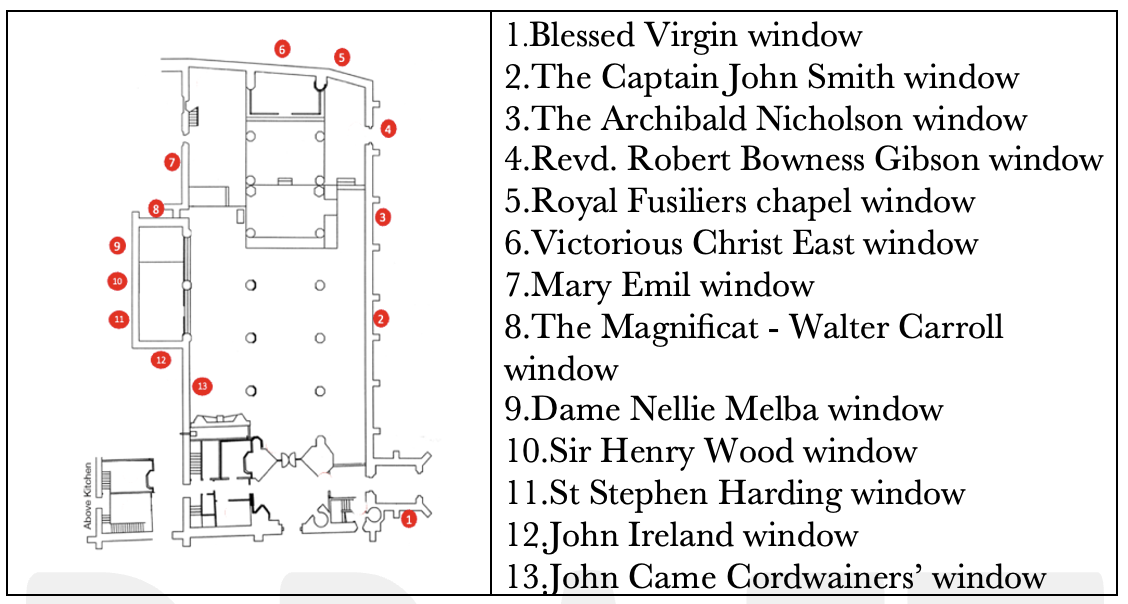
There is no current evidence that the church possessed any stained-glass windows after the Great Fire until the early part of the nineteenth century but has a history since then of a love of stained glass and of those who design and create stained glass wanting to design for St Sepulchre. This is indicated by not just the number of stained glass but the commitment to replace bomb damaged windows such that it is considered to have one of the most comprehensive ranges of twentieth century glass at least in the City of London. For example, in 1867 the east window was filled with glass by Lavers and Barraud, in which the lowest panel depicted the Crucifixion. It was, judged by modern standards, a poor window, although its colouring in sepia lent a pleasing mellow light to the church. This window had been badly damaged in an air-raid in the 1914-1918 war, and was completely destroyed by enemy bombs in 1941. A better window by Clayton and Bell (1884) filled the large west window. This also was destroyed in the same air raids and has not been restored. There was also a window (that some at the time classed as a “very poor one”in the south aisle. This too was destroyed at the same time.
The church has now (2025) eleven major and two smaller fine modern stained-glass windows, although there is a competition currently in progress to design and install a new window to commemorate the Royal Fusiliers who fought, along with others, in the Korean War, and to celebrate the contribution veterans make.
The following are extracts from Brian Grumbridge’s book, “Sepulchre: The True Story” available from the church.
1. THE PORCH WINDOW (Designer Unknown, installed Unknown)
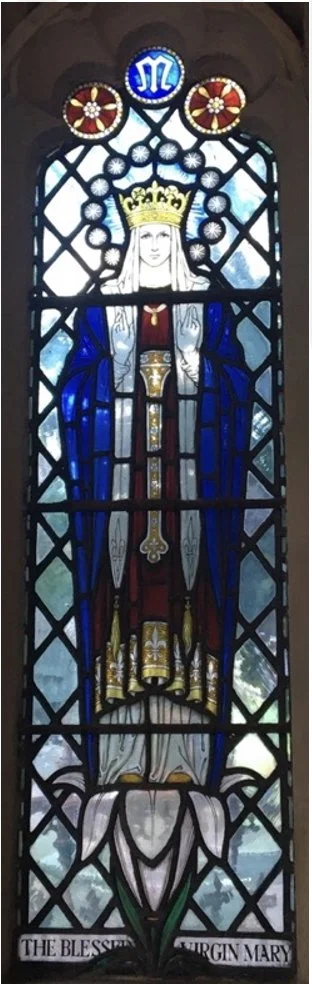
There were, before they were destroyed on May 10th, 1941, three stained glass panels on the west side of the interior of the church porch, placed there "in memory of Ann, wife of Matthew Henry Woodhill. Died 25th June, 1891." These have been replaced by a single panel depicting the blessed Virgin. The base is her emblem of the Lily and the Fleur de Lys. The twelve stars around the halo symbolize the Twelve Apostles.
We are still trying to find out more about this window. If you know anything about it please get in touch. Thank you.
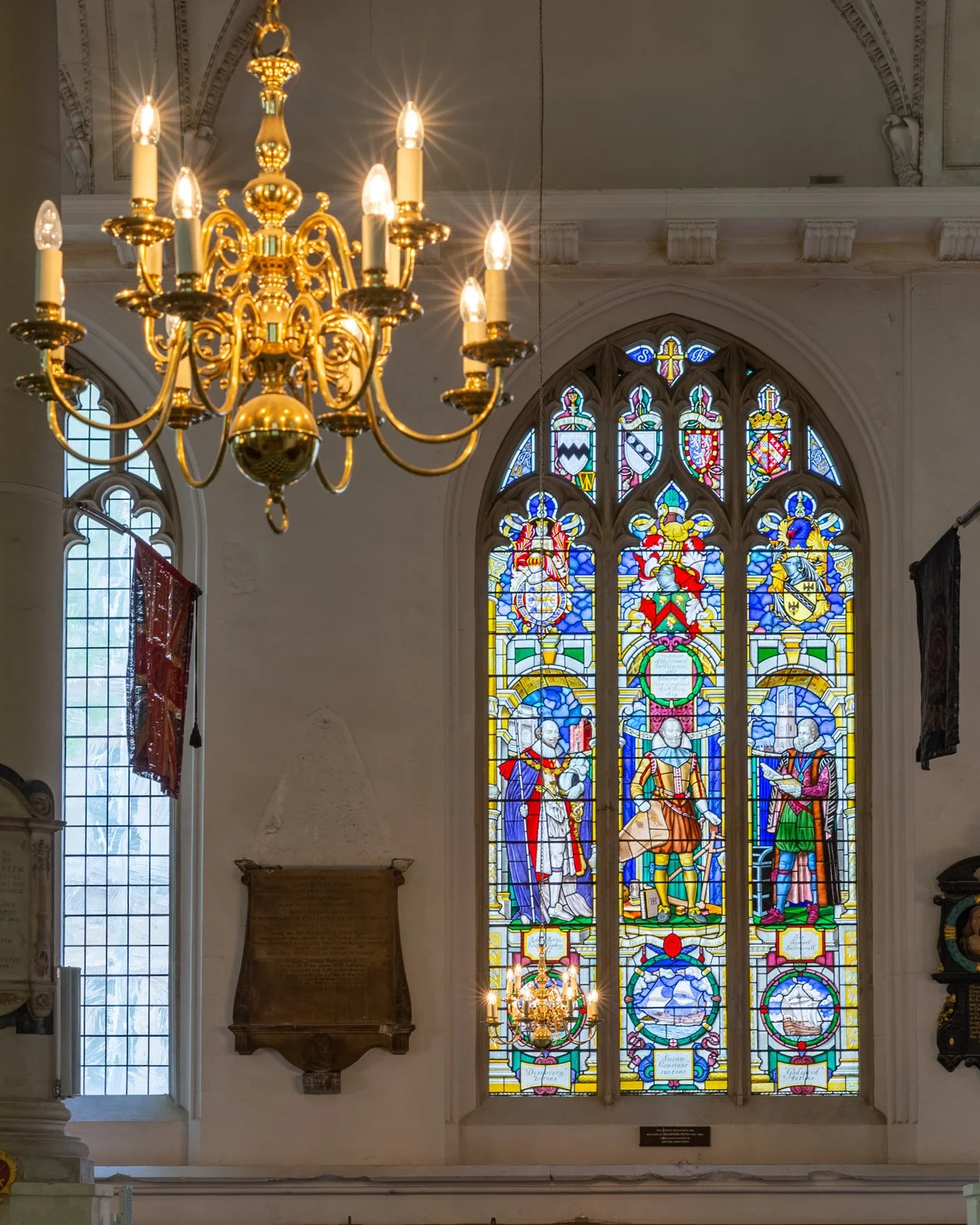
2. THE CAPTAIN JOHN SMITH WINDOW – (Designer Francis Skeat, installed 1968)
In August 1967 a faculty was obtained for: “The introduction into the Parish Church of St Sepulchre with Christ Church Greyfriars and St Leonard Foster Lane of a Stained Glass Window in memory of Captain John Smith.” The PCC had approved this on 27 October 1966, the estimated cost being £2,250 which had already been promised. The window was designed by Francis W Skeat in 1968 (Fellow British Society of Master Glass Painters). The original design had been sent to the College of Arms and their amendments, from Robert Dennys, Rouge Croix Pursuivant of Arms, had been incorporated.
3. THE ARCHIBALD NICHOLSON WINDOW - (designer Gerald E. R. Smith, Installed 1938)
This fine window bears the following inscription: "To the glory of God. In memory of Archibald Keightley Nicholson, Master Glass Painter, who worshipped in this church. This window is designed and carried out by the craftsmen of his studios as a thank offering for his life and friendship, 1871-1937." Archibald Keightley Nicholson was one of the greatest stained-glass artists of his generation. Of his art, the Dean of York (E. Milner White) has written: "The principle that a window exists for the purpose of admitting light dominates all his work....Few men could have more long-lasting or more widely scattered evidence of their work. His windows can be seen in almost every corner of England, and among the cathedrals containing them are Lincoln, Wells, Worcester (the memorial window to Sir Edward Elgar), Chester, Norwich and Carlisle.
4. THE HOLY SEPULCHRE, RESURRECTION WINDOW (Designer Gerald E.R. Smith, installed)
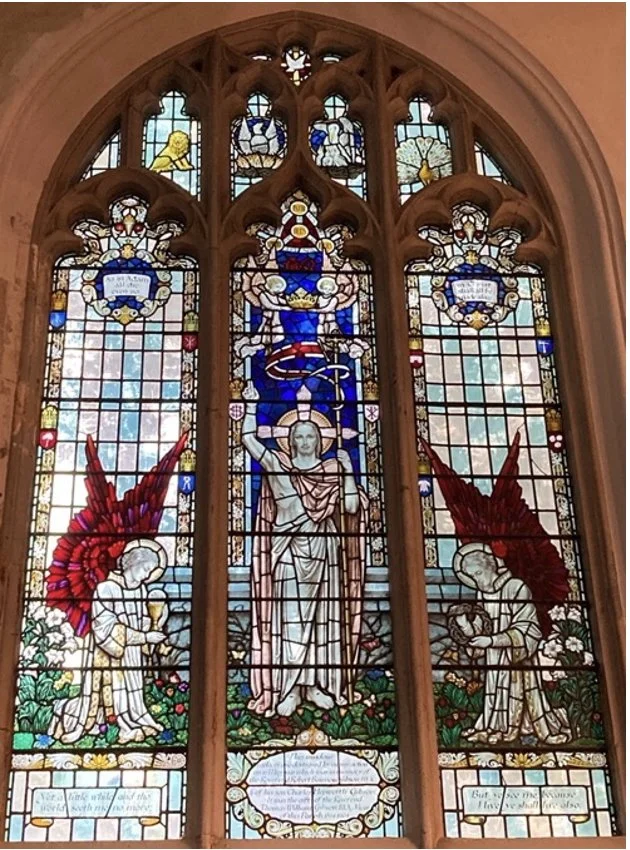
A window in the south aisle depicting our Lord's Resurrection from the Holy Sepulchre was destroyed at the same time as the east and west windows. It has been replaced by a new Resurrection window in which Christ is shown standing before the empty tomb. The artist thus describes it: "Our Lord holds the Banner of the Cross with His right hand raised in blessing. The tomb is in the background, while above Him angels hold the Celestial Crown. At the apex is the ancient symbol of the Trinity with the 'Alpha' and 'Omega' beneath; the border is composed of the Vine. In the outer lights are two angels, one holding the Chalice and Paten and the other the Crown of Thorns. In the foreground are spring flowers and butterflies, emblems of the Resurrection, as are the borders of the outer lights (the budding thorn). The small shields contain emblems of the Passion. The emblems in the tracery lights are the Lion (the Lord of Life), Phoenix (Immortality), Pelican (Redemption), Peacock (Resurrection), while at the top is the Holy Spirit in the form of a dove."
5. THE EAST WINDOW, REGIMENTAL CHAPEL, ROYAL FUSILIERS – (Designer Gerald E.R. Smith, installed 1952)
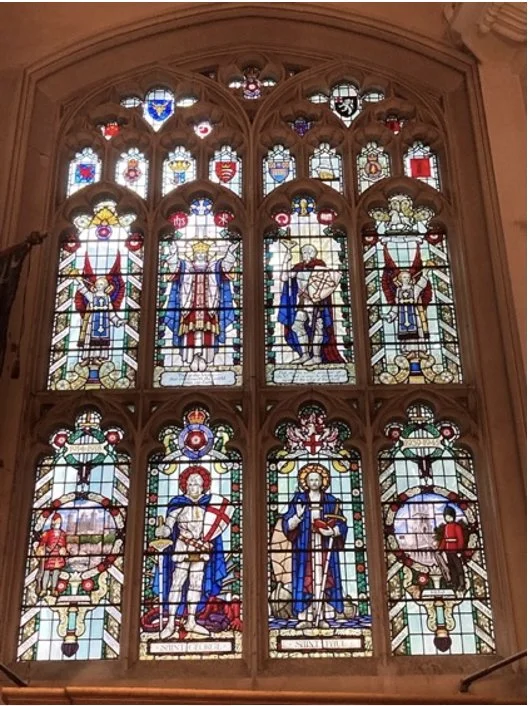
This window, which contains eight lights with traceries, was dedicated by the Chaplain General (Canon Pike) on Remembrance Day, 1952. The main theme of this window is to suggest our Lord's instructions as to the ideal outlook of the soldier. Figures include those of St. Paul and St. George. One medallion shows the Tower of London with a Royal Fusilier of that period; the other shows Sepulchre's Church and the Regimental Garden of Remembrance. The figure here, in full dress uniform, is that of a Royal Fusilier to-d The borders contain the battle honours of the Regiment, and traceries depict various coats of arms, badges and divisional signs
6. VICTORIOUS CHRIST EAST WINDOW – (Designer Gerald E.R. Smith, Installed 1949)
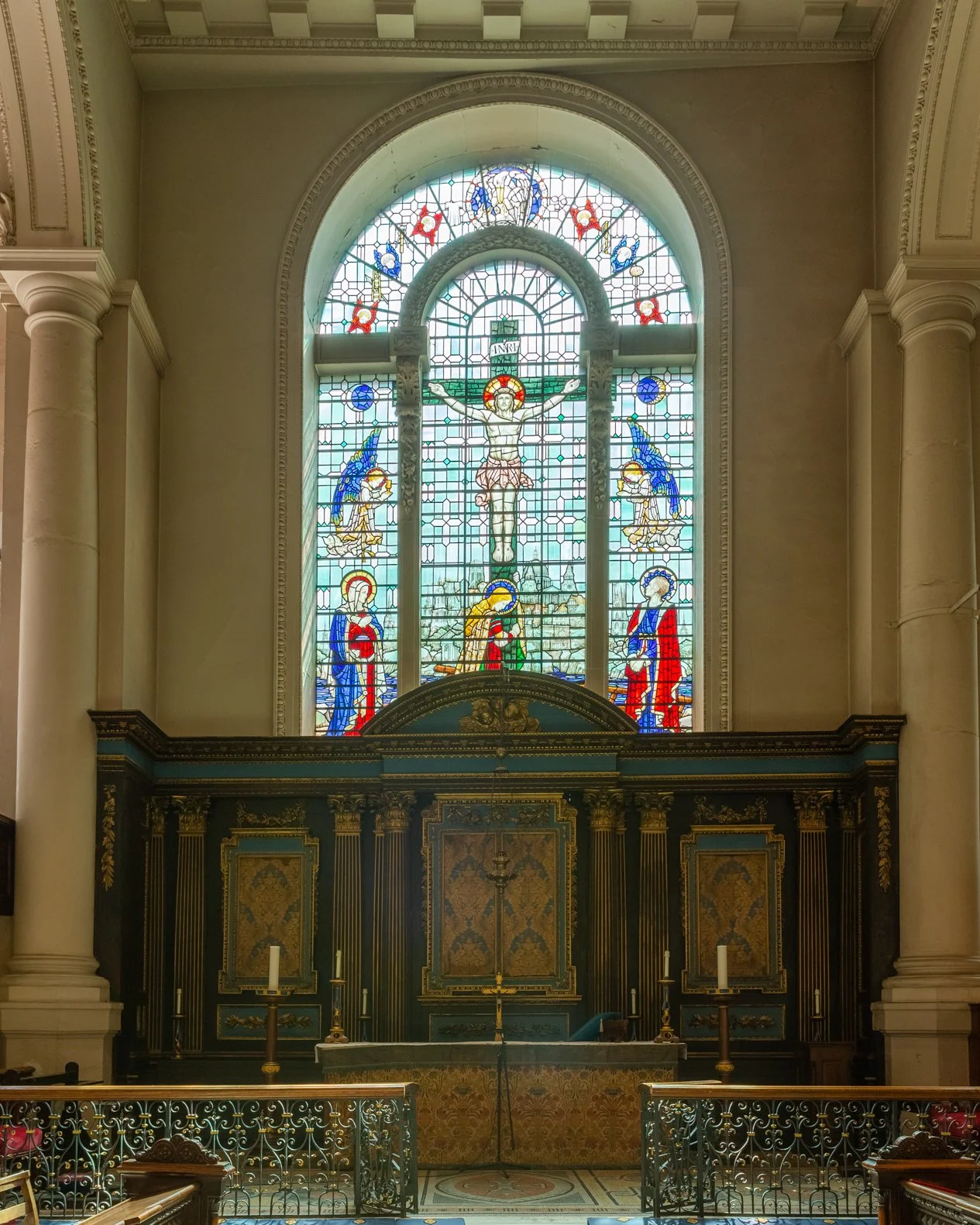
Before the bombing, the east window contained a representation of the Crucifixion. It was the picture of a seemingly defeated Christ. This was shattered in an air-raid in 1941, and was replaced in 1949 by the present beautiful window depicting not a defeated, but a victorious Christ reigning over the City. This is the artist's description of it: "In the centre light is the Living, Victorious Christ on the Cross. At the foot of the Cross is St. Mary Magdalene with the pot of precious ointment. In the left light is the Blessed Virgin with St. John the Evangelist on the right. Above these figures are adoring angels holding golden chalices, and at the top the darkened moon and sun. "In the semi-circle at the top are cherubs and the emblems of the Passion. In the centre is the Pelican feeding its young with its own blood. This is the ancient emblem of the Redeemer of mankind and the symbol of loving sacrifice. Behind the Cross in the background is the Heavenly City, the New Jerusalem, typified by many of the Wren churches, some of which, though badly damaged by enemy action, will rise again in restoration, and others, alas, destroyed beyond repair. St. Paul's Cathedral can be seen immediately to the right of the Cross, with old St. Paul's on the left, Christchurch Greyfriars, St. Bride's, Fleet Street, St. Mary-le-Bow, St. Mary-le-Strand, St. Dunstan-in-the-East, St. Sepulchre's, and St. Martin Ludgate. River of Life flows between this imaginary City and the material world."
7. MARY EMIL MEMORIAL WINDOW – (Designer unknown, Installed unknown)
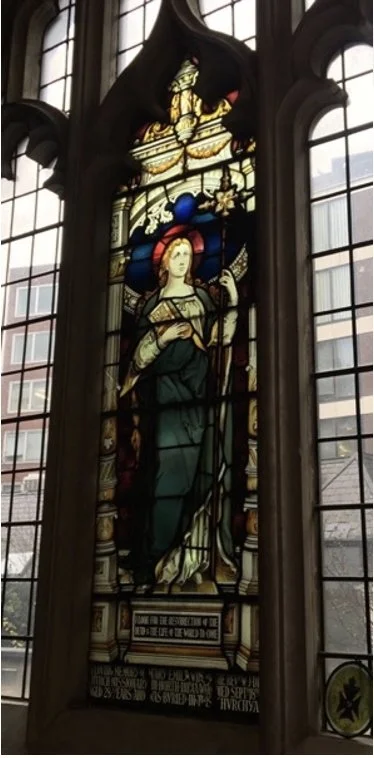
Behind the current location of the organ is a window dedicated to the memory of Mary Emil, the wife of Revd Deerr, ordained in 1818, a German weaver and missionary, who sent out by the Church Missionary Society to Burdwan and Krishnagurh, India. He died in 1833 and is buried in the churchyard., although his link with St Sepulchre is unknown. The wording towards the bottom of the window is: “I look for the resurrection of the dead & the life of the world to come.” And at the bottom of the window: “In loving memory of Mary Emily wife of the Revd W J Deerr Church Missionary in North India who died Septr 18th 1833.”
We are still trying to find out more about this window. If you know anything about it please get in touch. Thank you.
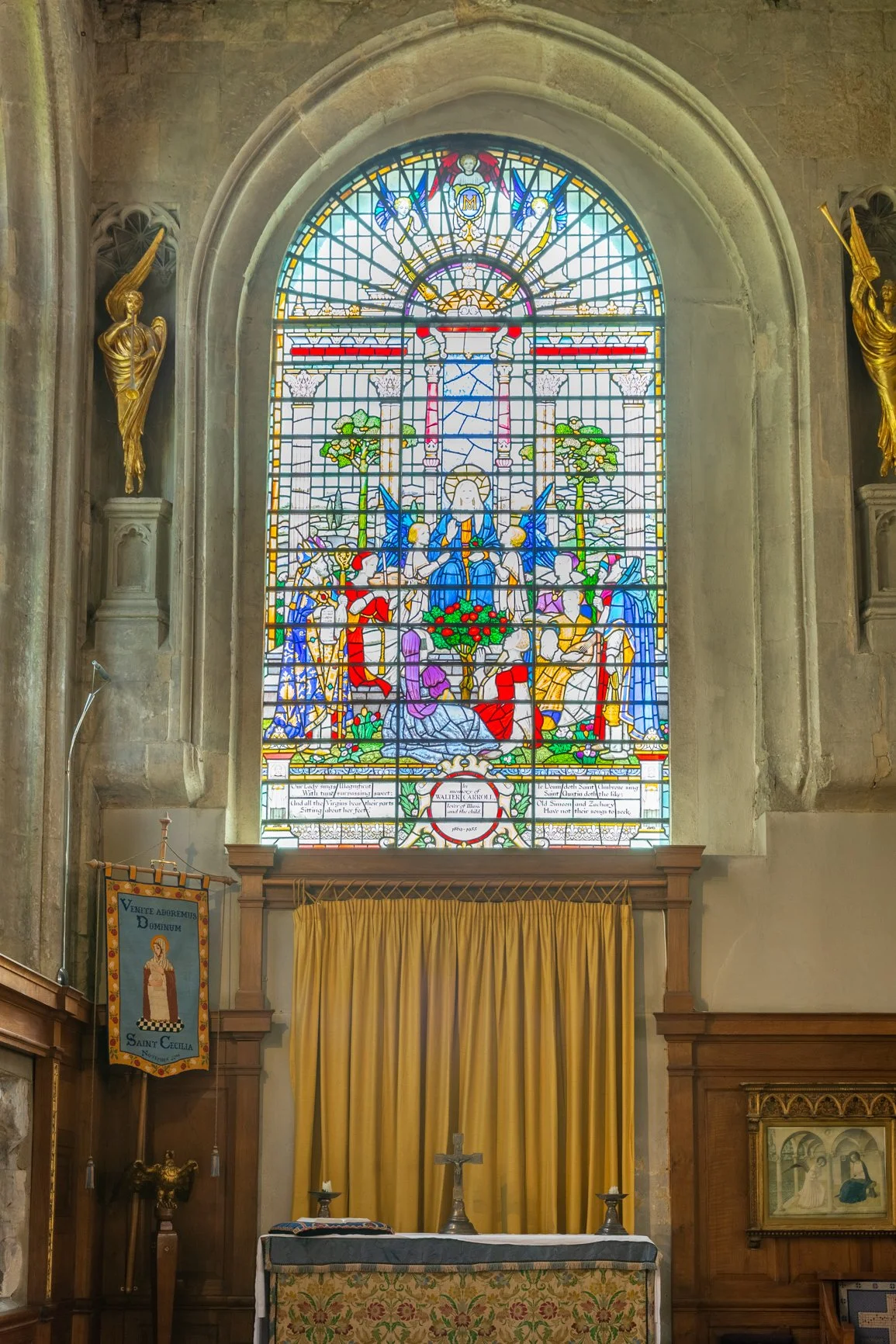
8. THE MAGNIFICAT – WALTER CARROLL MEMORIAL WINDOW – (Designer Gerald E.R. Smith, installed 1959)
Walter Carroll (1869-1955) was a British composer, lecturer and author. Having developed his choral experience at church and then the Halle Choir, he turned to lecturing at the University of Manchester, becoming Dean of the Faculty of Music in 1910. He is perhaps best known by musicians for his piano compositions, having written a substantial body of educational pieces for young pianists, some of which have been included in examination syllabi for the Associated Board of the Royal Schools of Music.
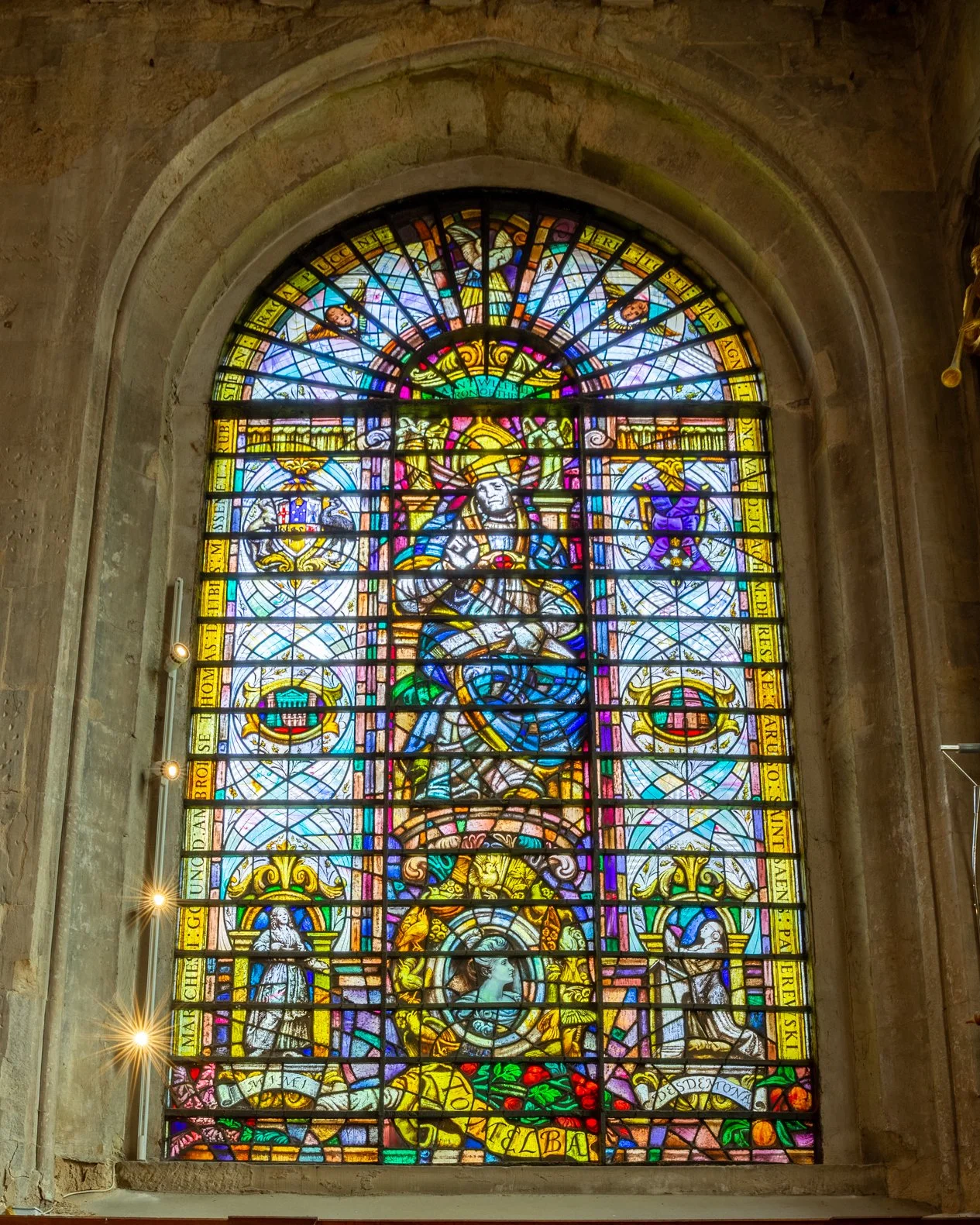
9. THE DAME NELLIE MELBA MEMORIAL WINDOW (Designer Brian Thomas OBE, installed 1962)
Helen ‘Nellie’ Porter Mitchell (1861-1931) was an Australian operatic soprano, who took her pseudonym from her home town of Melbourne. She was known for some of the greatest roles in opera, two of which – Mimi from La bohème and Desdemona from Otello – are featured in this window. Above them, the Royal Opera House (her “artistic home”) and the Royal Albert Hall (where she performed 26 times) are depicted. ‘’Fortunate the generation that heard her, for we shall not hear her like again’ wrote the New York Times in 1931, year of Melba’s death. She is watched over by St Wilfrid, a patron of the arts, and surrounding them are the names of composers and musicians: Marchesi, Gounod, Ambroise Thomas, Délibes, Massenet,Rubenstein, Braga, Puccini, Verdi, Tosti, Mascagni, Leoncavallo, Joachim, De Reszke, Caruso, Saint-Saëns, and Paderewski.
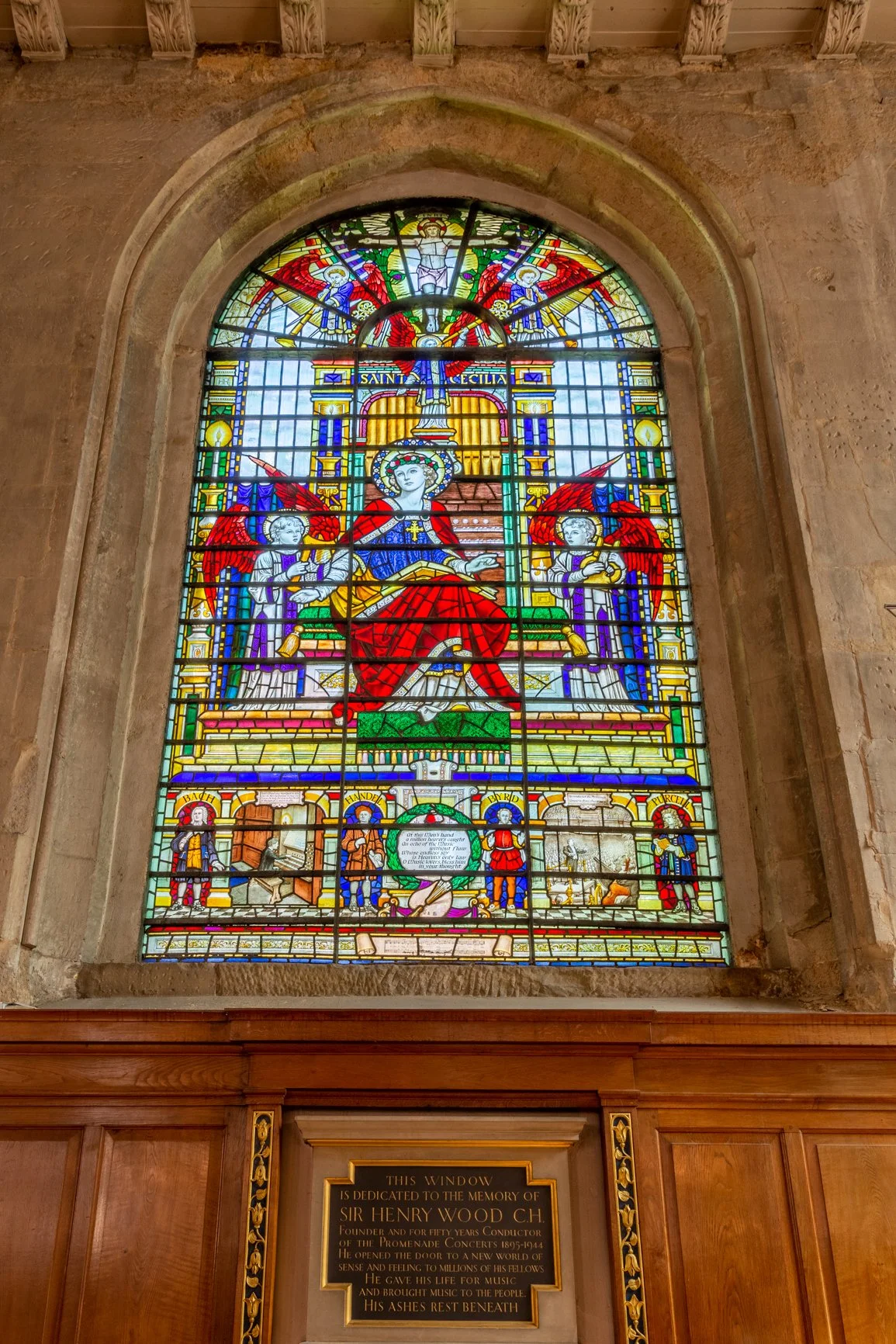
10. THE HENRY WOOD MEMORIAL WINDOW (Designer by Gerald E.R. Smith, installed 1946)
This window was unveiled by the Lord Mayor of London (Sir Charles Davis, D.L.) on April 26th, 1946, in the presence of a large and representative gathering of musicians. The orchestra conducted by Basil Cameron, was composed of members of the B.B.C. Orchestra and the London Symphony Orchestra. The choral part of the service was sung by the B.B.C. Chorus conducted by Leslie Woodgate and the Choirs of St. Paul's Cathedral and Westminster Abbey conducted by John Dyes Bower. A poem, specifically written by the Poet Laureate and set to music by William Walton was performed under the conductorship of the composer.
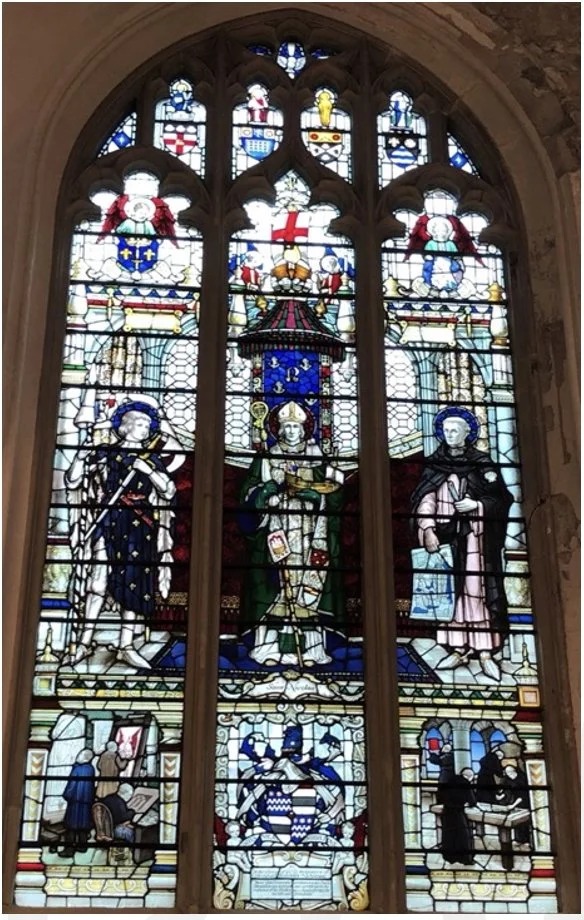
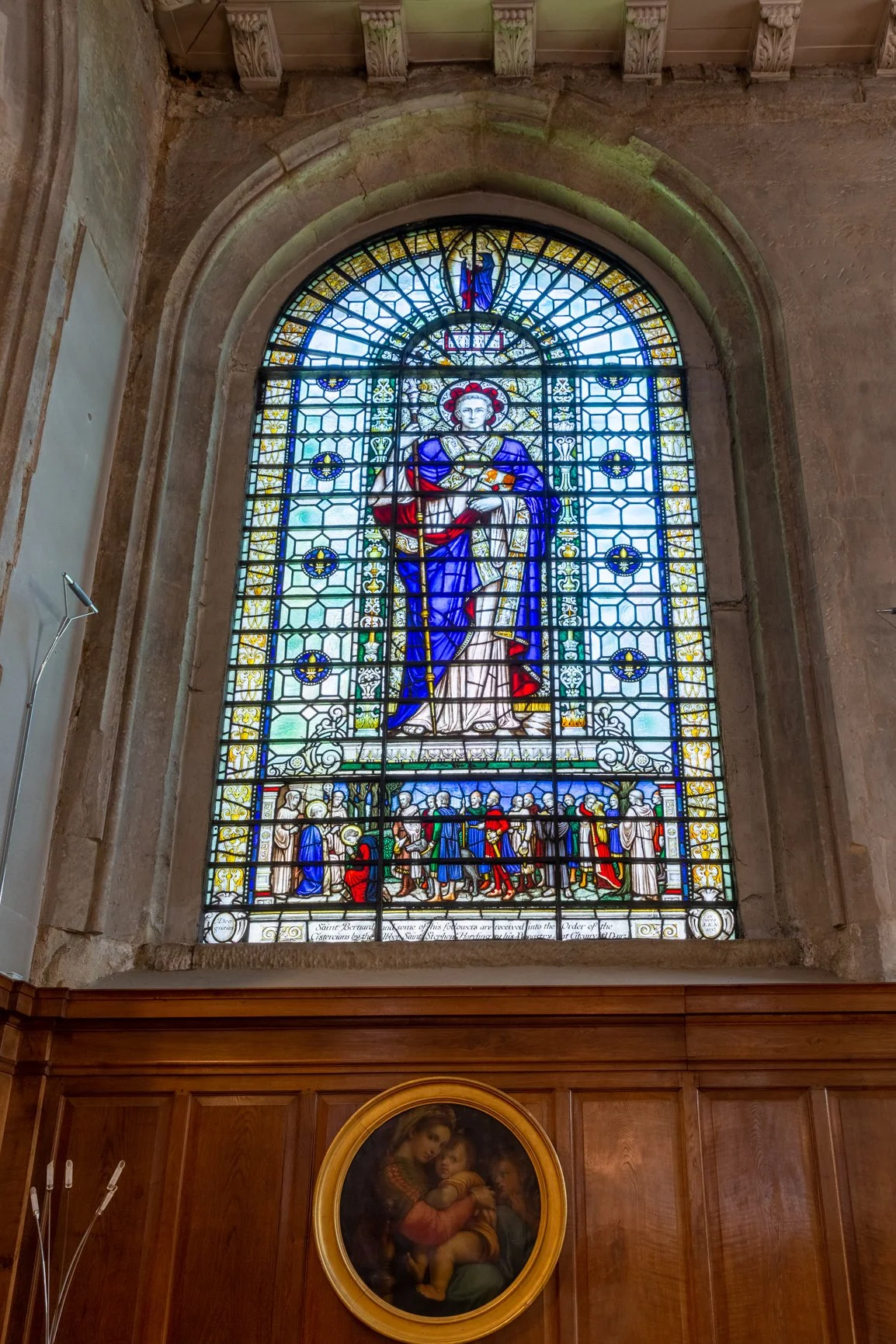
11. THE ST. STEPHEN HARDING WINDOW – (Designer Archibald Keightley Nicholson, installed 1932)
Archibald Keightley Nicholson, who died on February 25th, 1937, designed the St. Stephen Harding window and gave it as a thank-offering after recovery from a serious illness. This is the artist’s description,” In the centre is the figure of St Stephen Harding wearing a simple Cistercian habit over which is a rich cope. He is holding an abbatial staff and the volume of the Bible which he himself transcribed. The little subject above the Virgin is an allusion to his vision and is particularly appropriate as the Cistercians hold Our Lady in great honour and dedicate all their churches to her. The scene below is the arrival of St. Bernard and his followers to be received into the Community of the Cistercians after they had broken away from the Benedictine Order. They are being received by St. Stephen Harding and his attendant monks.
12. JOHN IRELAND MEMORIAL WINDOW – (Designer Brian Thomas OBE, installed 1963)
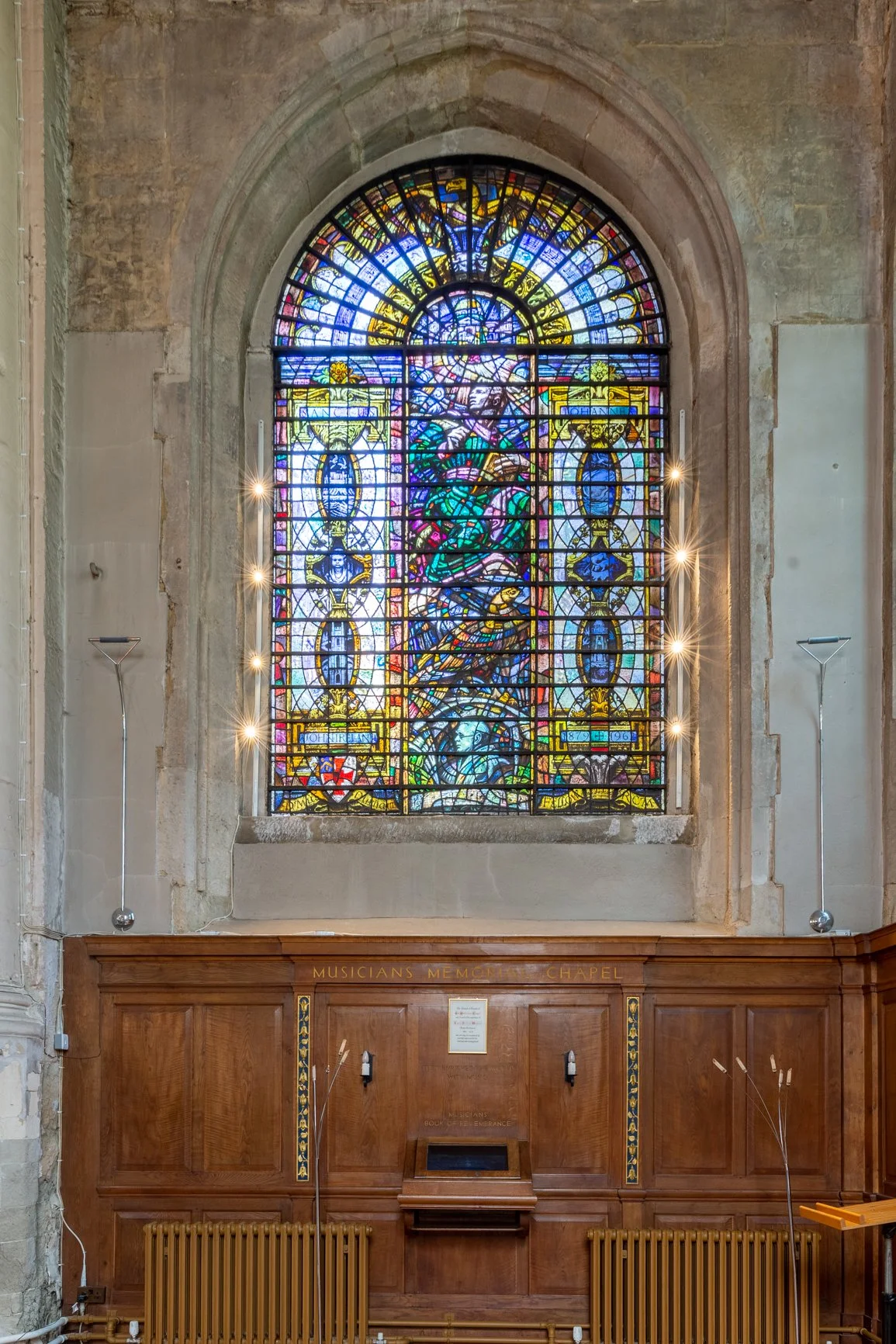
John Nicholson Ireland (13th August 1879 – 12th June 1962) was an English composer and teacher of music. His output consists of piano miniatures and of songs with piano plus large-scale compositions for orchestra, a piano concerto, a choral work, These Things Shall Be, as well as sonatas (for piano, violin, cello and clarinet) and three piano trios. From 1923 he taught at the Royal College of Music. His pupils there included Richard Arnell, Ernest John Moeran, Benjamin Britten, composer Alan Bush, Geoffrey Bush Anthony Bernard and Percy Turnbull. He was an organist and choirmaster for many years in Chelsea, and his church music is among the finest written in our time. It is of special interest to recall that his anthem ‘Greater love hath no man’ was composed in 1912 and dedicated to Charles Macpherson and the choristers of St Paul’s Cathedral.
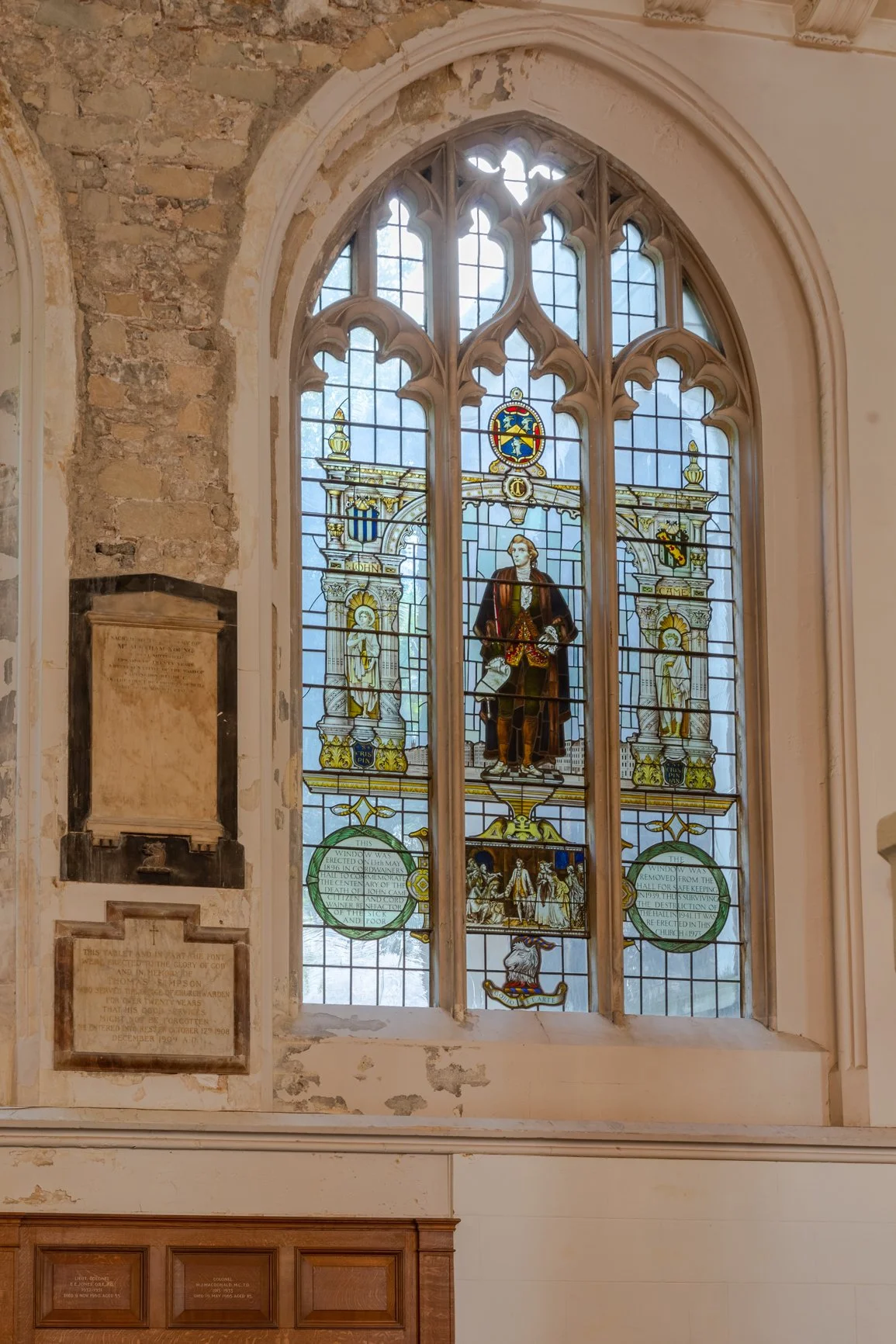
13. JOHN CAME CORDWAINERS’ MEMORIAL WINDOW – (Designed by Unknown, Installed 1973)
This window is unusual in that it was never designed to be a church window. The Cordwainers ancient guild were associated with the trade in fine leather from Cordoba in Spain. At the start of the Second World War in 1939 the window was removed from the Cordwainers’ Hall for safe storage. The window commemorates John Came, a benefactor of the Company and Master in 1780, who died in 1796. It was made in 1896 and Came is shown in period costume with a livery gown. The Cordwainers’ Arms, St Crispin and St Crispinian, John Came's’ and the Master of 1896 Arms, and Came distributing to the poor are shown.
14. ROYAL FUSILIERS KOREAN WAR COMMEMORATIVE WINDOW
In October 2024 a competition was launched to design, manufacture and install a window to commemorate the Royal Fusiliers role in the Korean War. The design brief being to:
- Commemorate the Korean War and the sacrifices made by those who fought,
- Recognise the Royal Fusiliers and all who served alongside them in Korea, and
- Honour veterans’ contributions to business and society after their return home.
His Royal Highness the Duke of Kent, in his role as Colonel in Chief of the Royal Regiment of Fusiliers agreed to be Royall patron for the project and a launch event was held at the church on 3rd February 2025.
At the time of writing the project was progressing and three designers had been selected after submitting an initial design outline for full design development and costing. The expectation is that a final design will be selected by 31 December 2026 and installation completed by 31 March 2028. The expected cost and fund-raising target is £120,000.
Volunteers needed
We are looking tio do a more comprehensive research project about the windows. Please get in touch if you ware interested in getting involved.