Resounding Future: Digital Heritage Research and Innovation Project
Rekindling the Past to Build our Future
For nearly 900 years, Holy Sepulchre has been at the heart of the City of London. Its manuscripts, parish records, memorials, artworks, military records and architecture tell not only the story of one remarkable church, but also of the people, communities and institutions that have shaped the City across the centuries. We are now looking to research, capture and share more of this story.
Holy Sepulchre’s Digital Heritage Research and Innovation Project:
is creating a living digital knowledge base that brings these collections together through careful research, digitisation and modern digital technologies. More than simply preserving historic records, the project seeks to reveal connections, unlock new stories and make this nationally significant heritage more accessible for research, education and public engagement, and
is developing and documenting a robust methodology for collaborative digital heritage research. By combining archival scholarship, linked knowledge management, carefully governed AI-assisted research and transparent provenance, we aim to evaluate what works, publish our findings and create practical guidance that can benefit other churches, archives and heritage organisations.
The Digital Heritage Research and Innovation Project builds on a couple of significant initial research projects, including the two years of research to produce Sepulchre: The True Story completed in 2024 and a National Lottery Heritage Fund Resilience project started in January 2026. Volunteers and partners can contribute to activities such as digitising archive material, transcribing historic manuscripts, researching people and places, documenting monuments and artworks, developing digital tools, or exploring innovative approaches to heritage research using emerging technologies. We are also open to explore joint research funding bids. To ensure the highest standards, all work follows agreed research methods, with sources, evidence and revisions carefully documented so that every conclusion can be traced, reviewed and built upon.
Progress to Date
The project is already well underway. We have established the core digital knowledge base using Obsidian, creating an interconnected environment where documents, people, places, events, artworks and research can be linked directly to their original sources. Existing digital material held at the church, including publications, research notes, historical records and photographs, has been incorporated into this growing knowledge base.
This provides the foundation for the next phase: systematically digitising archive material, transcribing handwritten documents, enriching the knowledge base through collaborative research, and exploring how emerging technologies can responsibly support heritage discovery. We believe this represents an innovative approach to understanding and preserving the heritage of a historic church, one that has the potential to inform similar projects across the wider heritage sector.
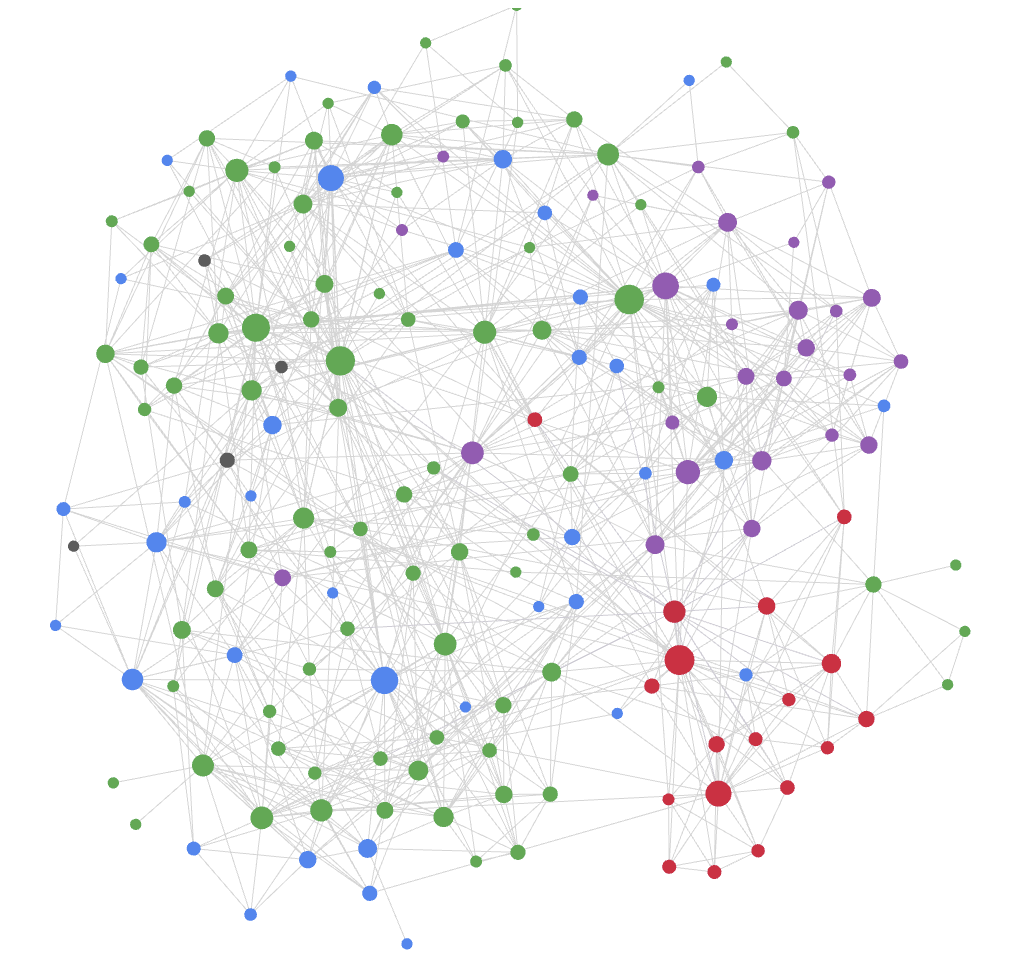
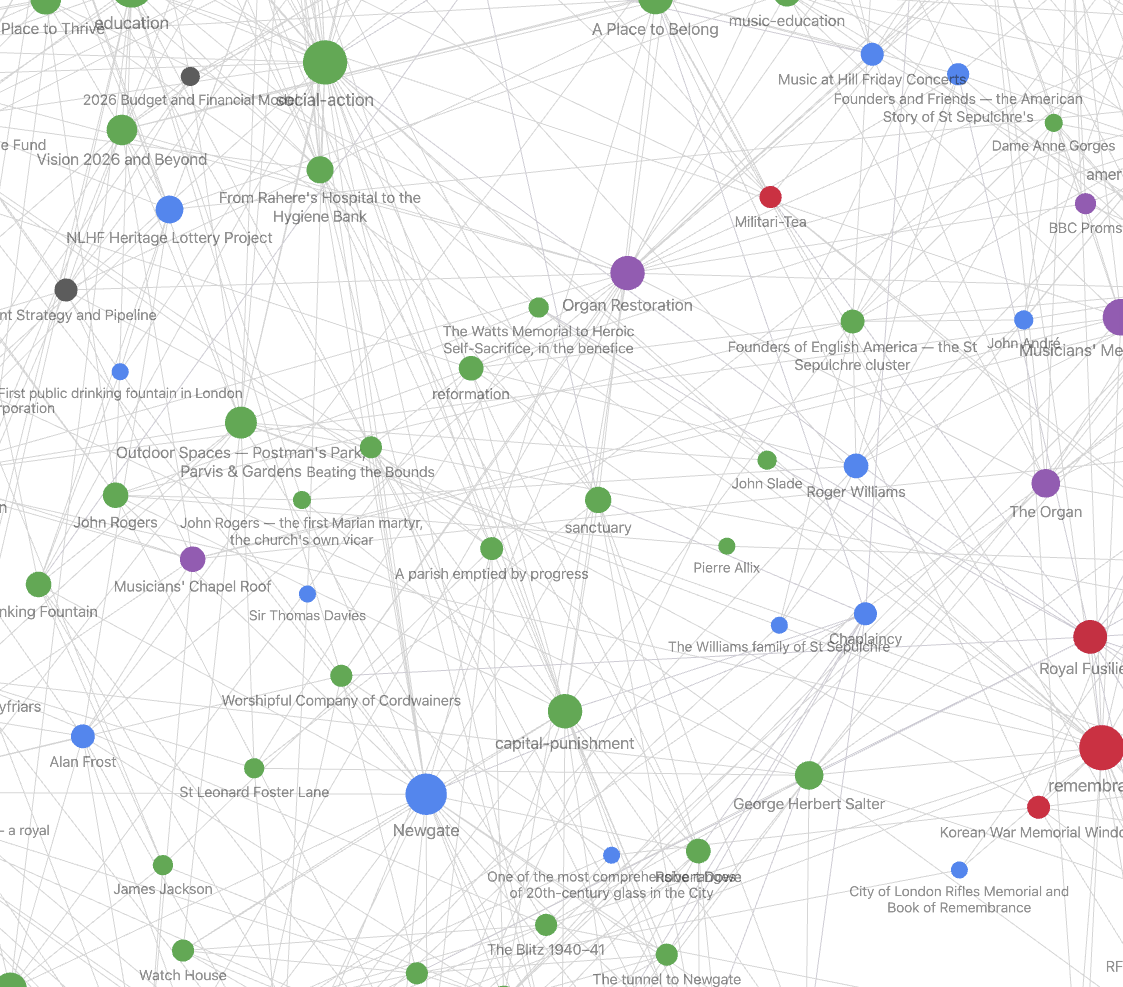
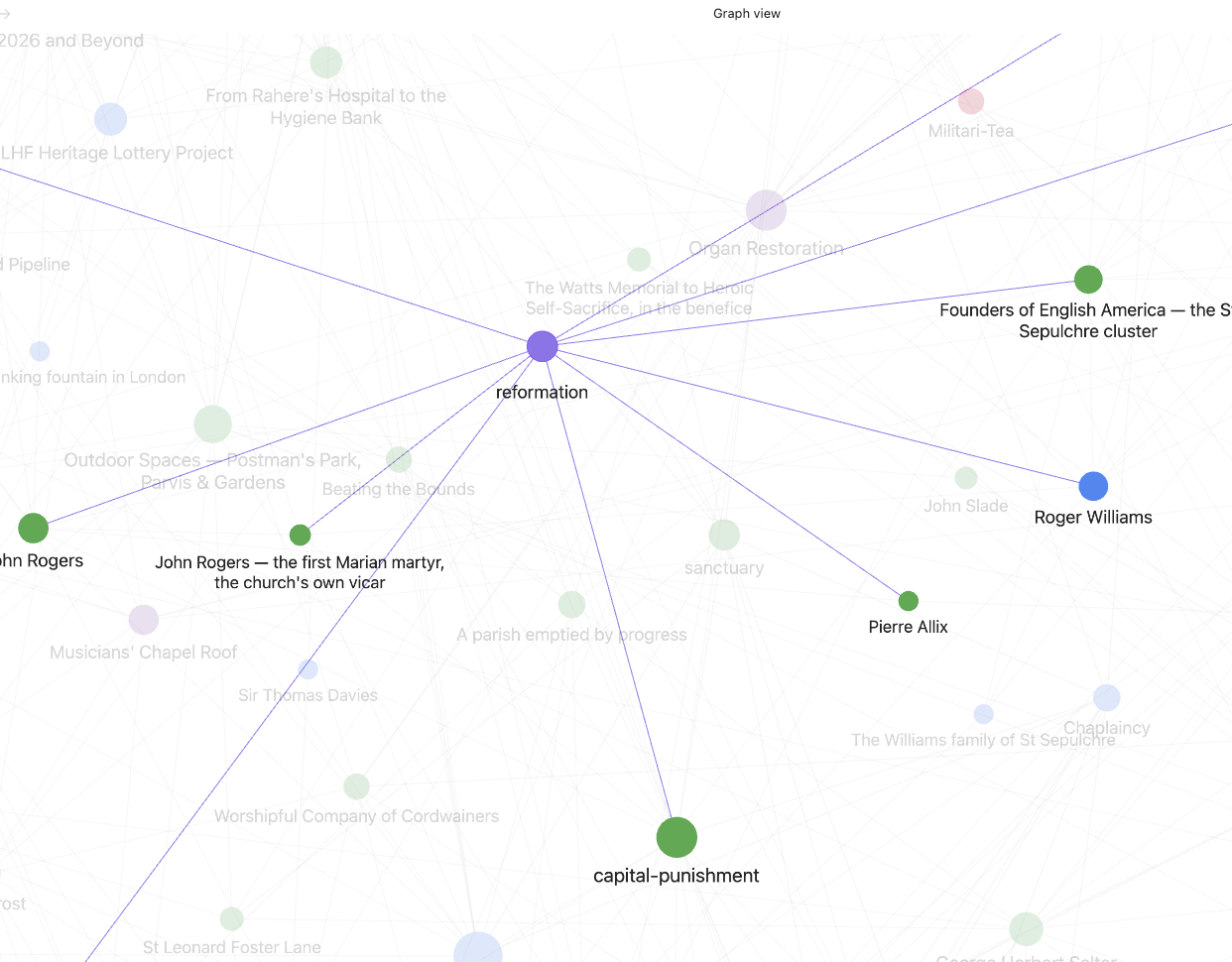
Building a connected knowledge base. Every document, person, place, monument and event is linked to its original sources, creating an evidence-based digital map of Holy Sepulchre's history that continues to grow as new research is added.
How to get involved
We welcome volunteers, historians, archivists, technologists, students and educators who share our passion for heritage. Some projects will also provide opportunities for schools and universities (subject to appropriate approvals), enabling students to develop practical skills in archival research, digital humanities and responsible use of emerging technologies. We also hope to work with academic partners to evaluate and publish new approaches that can help other churches and heritage organisations preserve, research and share their own collections.
Current research projects include:
Researching the historical evidence of the Tunnel between St Sepulchre church and Newgate prison (Project allocated)
Researching Sir Christopher Wren’s involvement in the rebuilding of the church after the Great Fire (Project allocated and completed)
Researching whether St Sepulchre was the location of the first full peel in 1690 (Project allocated and completed)
Researching the influence of John Rogers, vicar of St Sepulchre and first Protestant martyr under Mary I (Project Allocated and completed)
Researching the derivation of the name Holy Sepulchre; links to the Church of the Holy Sepulchre in Jerusalem, Links to the Crusades and whether it was a place for pilgrims and crusaders to gather before leaving England for the Holy Land (Project allocated)
Researching whether St Sepulchre is the location of the curfew bell in the Middle Ages; what did that signify, and when did the curfew bell ring from the church for the last time? (Project allocated)
More to be added.
Current digital innovation and data capture projects include:
Digitise the military rolls of honour: WW1 and WW2 records provide full details which are inconsistent with National Archives, capture and (Project being explored)
Crack the handwriting: Centuries of this church's own records exist but nobody can read them at any speed and so a machine learning solution is needed. (Project not yet allocated)
Address the outstanding claims and artifacts: The vault has identified some knowledge and signficance gaps and there are opportunities take any one of the open questions. Explore the reasons and identify the path to resolution. (Project not yet allocated)
More to be added.
Current visitor engagement projects include
Development and piloting of Heritage & Wellbeing Tours for led sitting talks or journeying organised groups, individuals at office desk or physically around route via App, or using virtual reality at home or in church to extend inclusivity (Project allocated and in progress)
Development and piloting of heritage artefact engagement using virtual reality technology (Project allocated)
Build the chat that answers for 900 years: Enable in person and online visitor retrieval over a knowledge base that grades its own evidence, that also offers oppportunities for knowledge contribution, with appropriate validation and review (Project not yet allocated)
More to be added.
Together, we are not only preserving the past, we are building a lasting digital legacy that will support research, learning and public engagement for generations to come. Do get in touch with Fr Nick to find out more.