
Our History - Postman’s Park and the Watts Memorial
The Watts memorial and the majority of the land in Postman’s Park is the responsibility of the Incumbent of the benefice of St Sepulchre without Newgate with Christ Church Greyfriars and St Leonard Foster Lane, with the gardens maintained by the City Gardens’ Team.
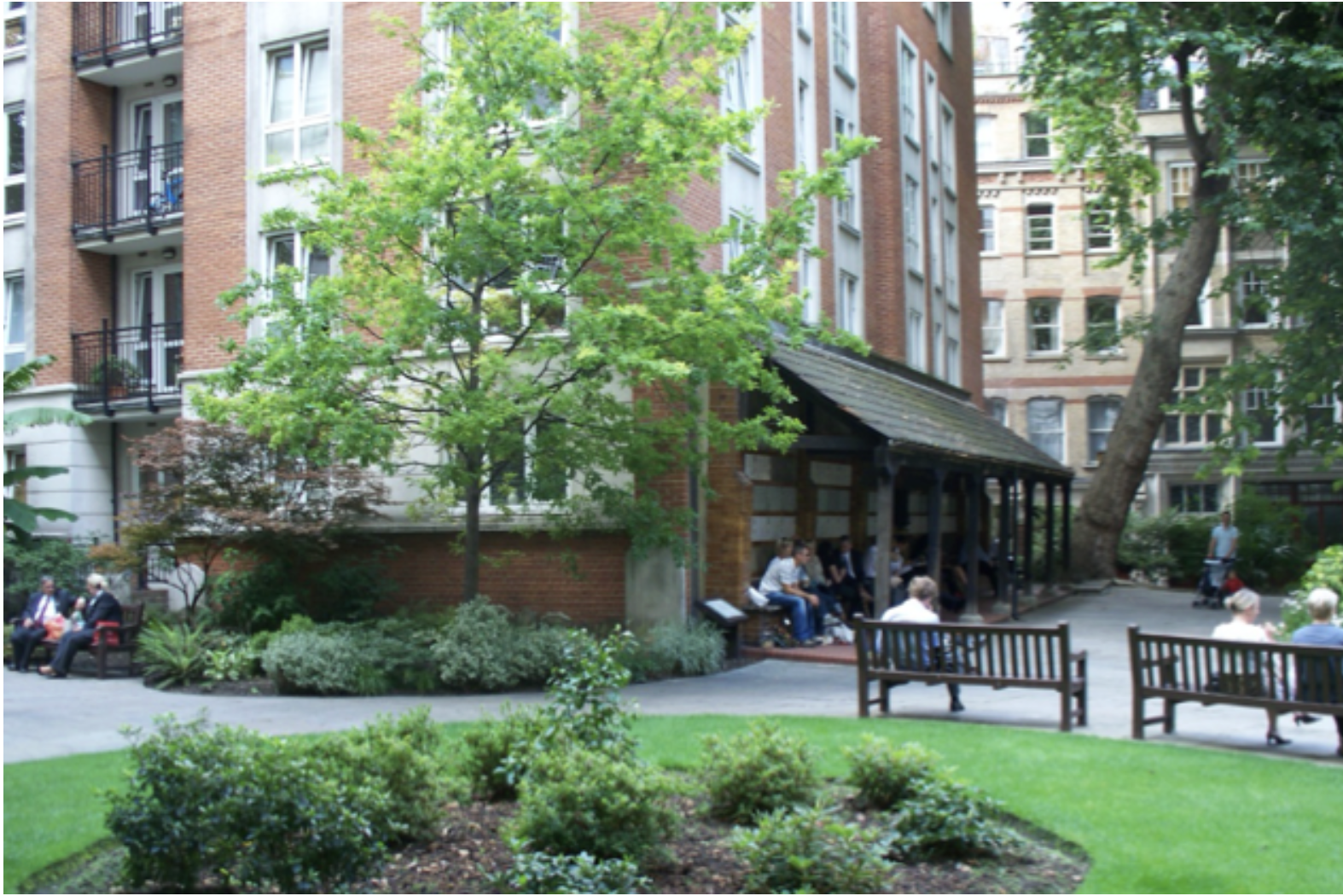
Postman’s Park
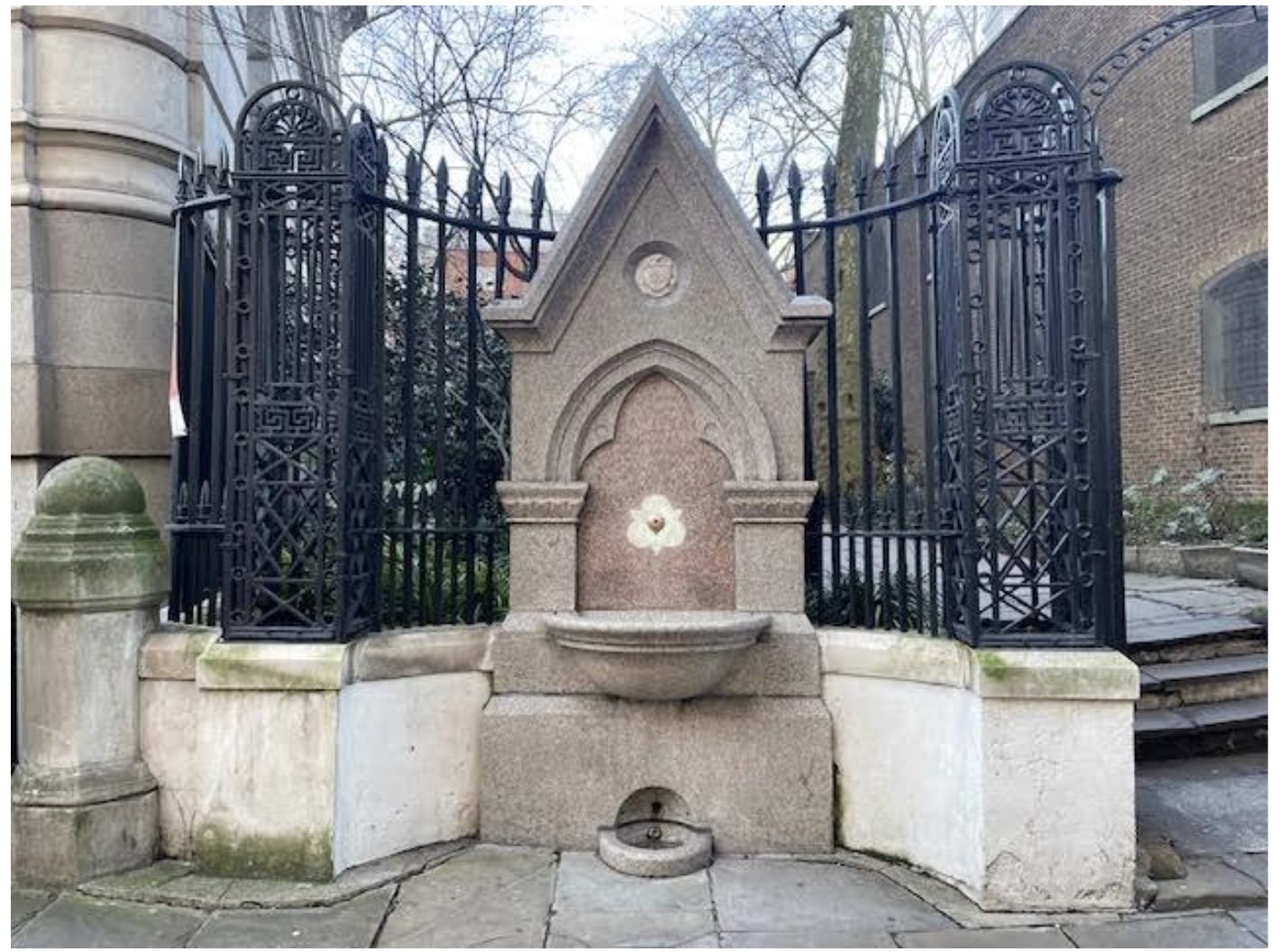
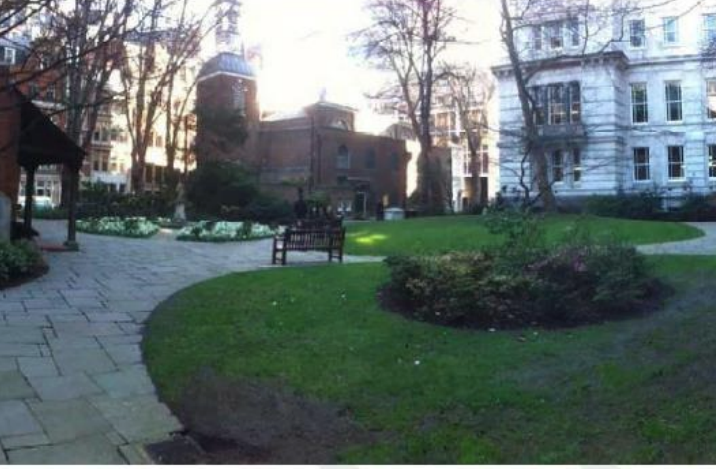
Postman’s Park is a public garden in central London, a short distance north of St Paul’s Cathedral. Bordered by Little Britain, Aldersgate Street, St Martin’s Le Grand, King Edward Street, and the site of the former headquarters of the General Post Office (GPO), it is one of the largest open spaces in the City of London. It is made up of 3 burial grounds, the Watts memorial as well as other memorials and a drinking fountain.
The 13th-century church of St Leonard, Foster Lane, about 200 yards (180m) north of St Paul’s Cathedral on Foster Lane, was badly damaged in the 1666 Great Fire of London, and was not considered to be worth the cost of repair. Instead its parish was united with that of the nearby Christ Church Greyfriars, which was rebuilt after the fire to a design by Sir Christopher Wren; the incumbent from that time onwards has held the joint titles of Vicar of Christ Church Greyfriars and Rector of St Leonard, Foster Lane. Although destroyed in 1666, the ruins of St Leonard, Foster Lane, were not cleared until the early 19th century. Despite the unification of the parishes, they continued to operate separate burial grounds. That of Christ Church Greyfriars was a short distance north-east of the church, on the eastern side of King Edward Street, while St Leonard, Foster Lane’s, was about 50 feet (15m) further east.
To the immediate south-west of the Guild church of St Botolph’s Aldersgate was a small irregularly shaped churchyard enclosed by Aldersgate Street to the east, the Christ Church Greyfriars burial ground to the west, housing and the burial ground of St Leonard, Foster Lane, to the south and housing along Little Britain to the north. The churchyard was used as a burial ground and as a public open space. As with other City churchyards, as the amount of available burial space in London failed to keep pace with the growing population it came to be used exclusively as a burial ground. A Royal Commission established in 1842 to investigate the problem (of lack of burial space) concluded that London’s burial grounds were so overcrowded that it was impossible to dig a new grave without cutting through an existing one. The Act to Amend the Laws Concerning the Burial of the Dead in the Metropolis (Burials Act) was passed in 1851. Under the Burials Act, new burials were prohibited in what were then the built-up areas of London. In 1858 it was decided to convert the churchyards to a public park and on 28 October 1880 the churchyard reopened as a public park.
The Watts Memorial
The painter and sculptor George Frederic Watts and his second wife Mary Fraser Tytler had long been advocates of the idea of art as a force for social change. … As the son of a piano maker, who reportedly despised the wealthy and powerful and twice refused a baronetcy, Watts had long considered a national monument to the bravery of ordinary people. In August 1866, he suggested to his patron Charles Rickards that he ‘erect a great statue to Unknown Worth’, and proposed erecting a colossal bronze figure. Unable to secure funds, the memorial remained unrealised. However, on 13 October 1898 the appeal was relaunched, with the proposal that if the remaining £3,000 were raised, Watts would design and build a covered way, which in due course would be lined with memorial tablets to commemorate the bravery of ordinary people. Watts planned to build a covered way around three sides of a quadrangle, with the roof supported on stone or timber columns. … Work began in 1899, and on 30 July 1900 the newly reunified park and Watts’s Memorial to Heroic Self-Sacrifice (also known as the Wall of Heroes) were unveiled by Alfred Newton, Lord Mayor of London, and Mandell Creighton, Bishop of London.
Initially four memorial tiles were manufactured prior to George Watt's’ death in 1904. His widow Mary too over and a further 24 were manufactured and by 1931 53 had been installed. In 2009 the Diocese of London consented to further addition to the memorial, and the first new tablet in 78 years was added.
A full list of the names on the memorials can be found on wikipedia - Link
Memorial to honour Barts Health staff who lost their lives to Covid-19
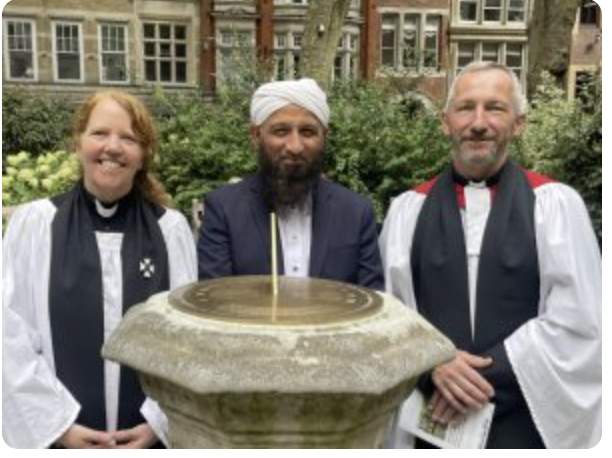
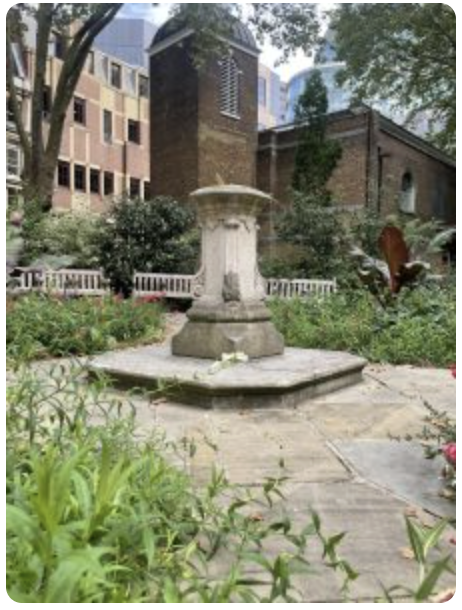
In 2024 a sundial was installed on an existing plinth within Postman’s Park, “In loving memory and recognition of the self-sacrifice of the Barts Health NHS Trust staff who lost their lives whilst caring for patients during the Covid-19 pandemic”.
Future Developments
Current restoration plans include the drinking fountain and the Watts memorial. After an initial condition assessment of the Watts Memorials, it has been agreed that a year long condition assessment is needed for the Watt’s memorial which will be starting shortly. Do get in touch if you would like to find out more or are interested in finding our more. See link at the top of the webpage.