
Our History - St Leonard, Foster Lane
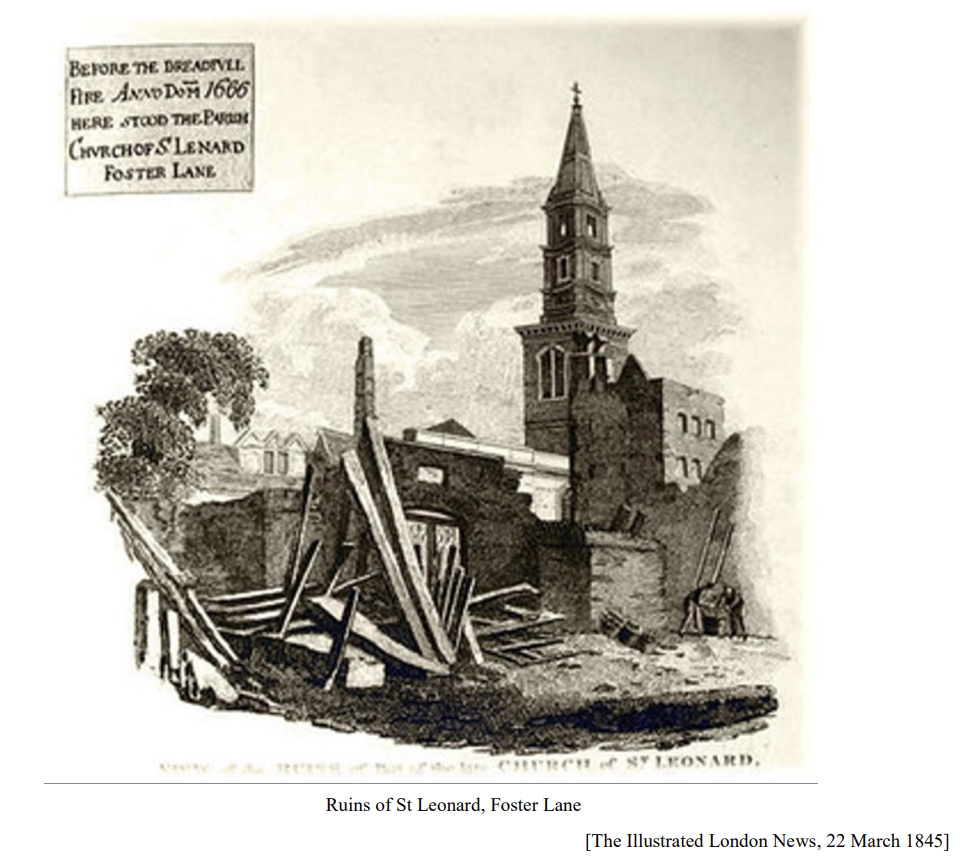
St Leonard, Foster Lane was dedicated to Leonard of Noblac and was on the west side of Foster Lane. Based on Newcourt the church was founded between 1231 and 1241 by the Dean and Canons of St Martin le Grand.462 It was largely destroyed in the Great Fire of 1666 and not rebuilt although some ruins remained until the early 19th century. In 1954 its parish, along with Christ Church, Greyfriars was merged with that of St Sepulchre’s. Its former burial ground now forms part of Postman’s Park.
According to James White:
“This church, known in old records as ‘Ecclesia Sancti Leonardi in Venella S Vedasti, London,’ originally belonged to the College of St Martin. It was founded about the year 1236 by William Kirkham, Dean of St Martin’s. The building was small, and stood in the courtyard of the Collegiate Church on the western side of Foster Lane on land now occupied by the Post Office, being originally built for the use of the inhabitants of the Sanctuary. When the excavations for the buildings of the General Post Office were in progress, a large quantity of bones and other remains were discovered, also various pieces of Gothic architecture – finials, crockets, and glazed tiles – which no doubt had formed part of the old church. The patronage was anciently with the Dean and Canons of St Martin’s, with whom it continued until that deanery was annexed to the Abbey of Westminster, the Dean and Chapter of which still retain it, together with the Governors of St Bartholomew’s Hospital.
1533 – A very fair window was placed at the upper end of the chancel at a cost of £500.
1618 – The church and spire were almost totally destroyed by fire, but were afterwards rebuilt.
1631 – The building was again repaired, and at the same time enlarged.
1291 – John de Marsland left rent for the maintenance of wax in the church.
Francis Quares, the poet, who died 1641, was buried here. Also Mrs Jodosin Frankland, ‘a Good Benefactress to Brazen-Nose College,’ Oxford. An engraved brass was in the chancel to the memory of Robert Parfitt, 1507. Also a stone without a name, but with the following inscription:
‘Live to dye.
All flesh is grass and needs must fade,
To earth again, whereof ‘twas made.’”
Sadly the Great fire AD 1666, destroyed the church and the parish was then united with that of Christ Church, Greyfriars and, subsequently, with St Sepulchre.